

Particle Snapshot
Access comprehensive patient clinical histories and AI-generated summaries to accelerate clinical decision-making.
Overview
Clinicians face an overwhelming volume of complex healthcare data, making it both time-consuming and challenging to navigate and interpret efficiently. Particle Snapshot solves this challenge by leveraging large language models (LLMs) to transform comprehensive medical records—both structured and unstructured, including clinical notes—into concise clinical summaries. AI Outputs deliver focused overviews of critical patient information at a glance.
Snapshot is available as a feature add-on within Particle Workbench and Signal. Summaries can be accessed through the Particle UI or programmatically via APIs in FLAT format.
How Snapshot AI Works
Particle's AI approach is designed specifically for clinical accuracy and relevance:
- Patient Profiling: AI builds a comprehensive patient profile with focused contextual search for chronic conditions, major surgeries, and key health events.
- Clinical Specialization: The AI dynamically assumes the perspective of the most relevant clinical specialty, surfacing data specific to that field beyond what general clinicians might search for.
- Data Extraction: Guided by clinical specialty context, the AI extracts key data points and flags missing information, including rare conditions and specialized lab markers.
- Reasoning and Refinement: Using agentic workflows, the AI iteratively improves summaries through thought-chaining and self-correction, ensuring high-quality clinical outputs.
- Grounding in Source Data: All AI-generated content is grounded in the complete patient record, utilizing maximum context to ensure accuracy and completeness.
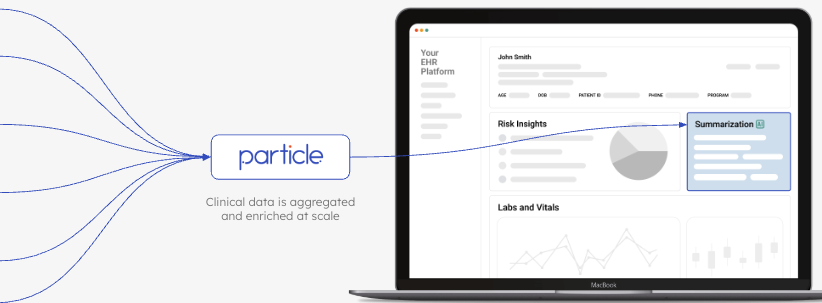
Key insights are synthesized and surfaced from comprehensive clinical records.
Use Cases
- Clinical Care: New patient onboarding, pre-visit preparation, post-discharge coordination, chronic care management, care transitions
- Population Health: Risk stratification, care gap identification, quality reporting, readmission prevention programs
- Analytics & Reporting: Member attribution, outcome tracking, provider performance analysis, quality measure calculations
Snapshot Templates
Longitudinal Patient Summary
Comprehensive overview synthesizing the patient's entire clinical history, including:
- Demographics and patient context
- Chronic conditions and diagnoses
- Major surgical history and procedures
- Current and past medications
- Recent lab trends and significant results
- Key health events and hospitalizations
- Social determinants of health
Best for: New patient onboarding, annual wellness visits, chronic care management, comprehensive care planning
Discharge Summary
Focused summary of a specific hospitalization, including:
- Admission details and presenting symptoms
- Hospital course and key clinical events
- Procedures performed during stay
- Discharge diagnoses
- Medications at discharge
- Follow-up recommendations
Best for: Post-discharge care coordination, readmission prevention, care transitions
More Snapshot Templates Coming SoonParticle is expanding our library of AI-generated clinical summaries. Contact your Particle Solutions team to learn more about upcoming output types and discuss custom use cases for your organization.
Access Methods
Snapshot is available through multiple access methods to fit your organization's workflows:
- User Interface: View AI summaries in the Particle UI alongside complete patient records when you query a patient.
- API: Retrieve AI summaries programmatically via APIs in FLAT format for integration with EHR workflows, clinical decision support systems, population health analytics platforms, and reporting tools. Supports both real-time clinical workflows and batch analytics processing.
Learn more: Accessing Snapshot via API
Have questions or unique use cases? Contact us – our team is ready to help you unlock the full potential of Particle Snapshot.
Updated 10 months ago